


Back to the classics
- Aynsley Vivian

- Dec 29, 2020
- 7 min read
Updated: Jul 24, 2022





Reading classical literature has never been my forte. Admittedly, there have been texts of old that have amazed and inspired me in many ways. But most of these have a commonality.
That is, they almost always relate to my Christian faith.
Around this time of year, after Christmas has come to a close, I do so wonder if we live as if it never really mattered in the first place? I wonder how often we consider God incarnate in the person of Jesus Christ?
Similarly, many people said that they would continue their count down to Christmas right after Christmas was over. I do so wonder if we should begin our countdown to Easter instead. Neither holiday is more important than the other. But as well as knowing that Christ came, we need to remember why Christ came.
When I consider much of classic literature, I am compelled to consider Christ's death and resurrection. Many of the romantics would focalize on Christ's humanity and his grievous death, but many would consider his resurrection and the means by which he brings forgiveness for the elect.
The classics
My favorite poem written to date is John Donne's Holy Sonnet XI, whereby he laments his sin that nailed an innocent man to the cross:
"Spit in my face, you Jews, and pierce my side,
Buffet, and scoff, scourge, and crucify me,
For I have sinn'd, and sinne', and only He,
Who could do no iniquity, hath died.
But by my death can not be satisfied
My sins, which pass the Jews' impiety.
They kill'd once an inglorious man, but I
Crucify him daily, being now glorified.
O let me then His strange love still admire ;
Kings pardon, but He bore our punishment ;
And Jacob came clothed in vile harsh attire,
But to supplant, and with gainful intent ;
God clothed Himself in vile man's flesh, that so
He might be weak enough to suffer woe."
Funnily enough, Donne is my least favorite poet as his metaphysical poetry often combines spirituality and sexuality in what I believe to be fairly unnatural and irreverent. Nevertheless, it is worth checking out his Holy Sonnets, they are amazing pieces of work.
More recently, my grandmother has recommended that I read George Herbert's poems and she lent me a collection called George Herbert: 100 Poems which have been absolutely beautiful and so elementally and foundationally present the gospel narrative, occasionally presenting it through the eyes and mind of Christ (which I should note is done in artistic airs: we must never take what is not scripture and ascribe it to God)
One of his longer poems, called "From the Sacrifice" beautifully presents the grief of Christ's death and the hours leading up to it. I was definitely weeping this as I read it out loud to myself. Christ's suffering was truly horrendous. The poem is quite long, but well worth reading. You can read it here.
"From the Sacrifice" actually reminded me of a poem I had written not long ago on Easter called "Denial".
"I cannot deny - the measure I owe
for not simply sin
But that it was borne
The maker to reap what the creature would sow.
You could not deny your Father's will.
Yet not your will but His.
A perfect man, burdened by the cup
Of wrath to which he would crawl.
Your closest friend would simply deny
That he even knew the man
To whom no deserved shame would fall,
That for this denial would die.
You did not fight back mockery with truth
Against those whom denied your rule.
Who troubled your body, enslaved your bones
To pain no dampened cloth could soothe.
To speak such truth would deny their lies
Would emphasize
That one who is perfect never denies
The reality hidden from eyes
Of blind men.
But rather than halt the denials of man
From whom no rescue plan
Can ever develop, you save in sacrifice
For all those who ran
To you.
And at resurrection, the revelation
The ultimate denial of blasphemy,
The king of the world, the defeater of death,
The mocked and denied is now risen,
Our salvation.
And no denial is potent enough
To alter that."
My poem when I remembered everything that Christ achieved though he faced numerous denials. Though many blasphemed him, whether Jew or Greek, he conquered all sin in his victory at resurrection. Herbert romanticizes Jesus' grief in "From the Sacrifice" but in the most reverent way. Most every scene leading up to and at Christ's death was tragic. The most perfection the world could ever see had come to its finale. Until of course, resurrection.
But Herbert in his poem "The Agonie", presents the burdensome sin that pinned Christ to a cross and the great love which we presently experience. He finishes his poem with these final two lines:
"Love is that liquour sweet and most divine, Which my God feels as [blood]; but I, as wine."
I weep with those two lines: how majestically that presents the love of God. It is a gruesome love: a love won by blood and pain. But it is a love nonetheless that we taste as the sweetest wine. The cup of wrath was filled with blood and poured on our sin as wine to make us white as snow. The imagery is complex, but that is the remarkable wonder of Christ's death and resurrection.
Sunday, the 27th of December
Today, we remembered the forgiveness of God in church, and we reflected on the sin that drove the nails into Christ's hands and feet and crowned him with thorns. The latter held my thoughts a little more. Thorns? I thought. The thorns that cursed the man after he sinned in the garden of Eden?
That which crowned God was the curse given to man. He was crowned with our sin. Perhaps this is the greatest irony of all. Our sin is what we wear as a crown and in pride. We showcase it to the world, though it is the very thing that brings us pain, just as it tortured Jesus.
And the nails? My mind went to Jael's judgement upon Sisera, where she drove the tent peg as an act of judgement upon this wicked ruler. It is not comparable. But both Jael's tent peg and Jesus' nails were acts of judgement (an act of judgement upon the innocent). And Jael was called to bring judgment, the Jews were not.
Why should Christ be cursed, why should he be judged and suffer death for the sin of man who deserved the nails and the thorns? Why should he be "weak enough to suffer woe" (Donne)? Well, there needs to be a perfect sacrifice, one God has required since sacrifices could 'cover' sin.. And another reason...
Love. A love as sweet as wine.
As a response, I wrote this poem:
"You are the better Adam.
You see your work
And call it good.
You toil over all you make
And call it your delight.
You are the light.
You trample the darkness
And crush the echoing silence.
You heal the man
Cursed to the ground
But judge that which is
Cursed to the ground
You tread the ground,
No whimpering sound
For bruise on heel,
And yet you heal
The blind and return their sight.
You grant them sight
As you blacken out
Carrying a load, a cup of blood,
Which drip, drip, drips
From head, from hand, from heel.
And tears from downcast woman
Mingle with blood,
then water
As it gushes
From
Your ribs.
The vinegar mingles too.
A stream flows down the mount
Of Death, of life, and now
Mockery.
More mountainous than mockery:
Spit
In his face, and
Tears
In his eyes, and
Blood
On his cheeks, from
Thorns growing into scalp, into
Temples.
The better Adam wearing the
Curse of Adam, whose ransomed
Blood now streams down
Tear-stained cheek.
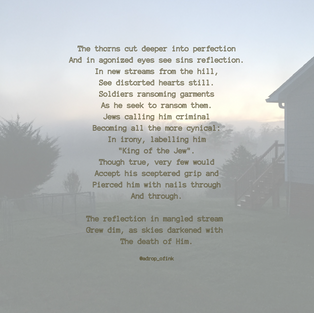
The thorns cut deeper into perfection
And in agonized eyes see sins reflection.
In new streams from the hill,
See distorted hearts still.
Soldiers ransoming garments
As he seek to ransom them.
Jews calling him criminal
Becoming all the more cynical:
In irony, labelling him
"King of the Jew".
Though true, very few would
Accept his sceptered grip and
Pierced him with nails through
And through.
The reflection in mangled stream
Grew dim, as skies darkened with
The death of Him.
You were the better Adam -
Rosemary, Thyme, Myrrh -
But time grew all too short -
Sage and Frankincense and Salt.
You called us to be the salt
Of the Earth, but we bring
Rosemary, Thyme, and Myrrh.
We run out of time, and walk
Out of time, and time is
Nothing to any of us anymore.
Selah
Salt
Crashes
To earth.
Her jar explodes as stone
Lays crushing the roses along
The tomb's cold wall.
No thorn can harm him now.
The river has dried, then we cried.
But the better Adam halts the tears
And now, a way for us, he clears."
Conclusion
There has always been a sort of passion within me for the gospel narrative as tied into other text. It is this sort of intertextuality that excites me. This feeling abounds in such texts whether they be contemporary or classics. I mentioned two main poets, Herbert and Donne, but there are many who beautifully present the gospel.
I think one thing I have yearned for is more Christian artists who are willing to express themselves creatively, but in a way that honors God. There is a time to reflect on the writing of the classics, but there is a time for all of us to speak up for ourselves.
I have formed a group with some friends where we seek to bring art that sparks conversation and promotes Christian thinking in a world that is growing more divided. The gospel is the pivotal uniting force in this world as it is the central narrative of our world (though many will not reject this truth). Christian art can spark division, but more than hurtful words, can bring change through beauty.
Herbert and Donne, whatever one may think about them, have become notable poets in our culture. They have been able to spark change even now, even in our post-modernist society.
Whether an artist or not, Christians are responsible for presenting this love of Christ on the cross, and the victory he has won for us. The way we present it may be clumsy, or it may be beautiful. But performance is hardly the goal, its the right heart.
And believe, whether you speak as Herbert or Donne, you are speaking to the hearts of people who will be impacted by the Spirit, if he so chooses to affect them. Simply pray, and watch beauty of the gospel orchestrate change in our world: something that has been happening ever since the classics were created.


Good work on reading the classics and writing some poetry of your own, Ayns. In your work and expression of thought I am in awe of our Lord's kindness to us. We did not and cannot deserve His lovely and super-abounding gifts (the Father qualified us; we did not qualify ourselves, Col.1:12). We can only receive the inheritance He promised and enjoy His eternal presence together as those 'called out of darkness and brought into the Kingdom of the beloved Son.' (Col.1:13) Love you, Ayns. ❤️ Dad
When you said, “There has always been a sort of passion within me for the gospel narrative as tied into other text. It is this sort of intertextuality that excites me.” It reminded me of how amazing it was this semester to be taking both the Old Testament and he New Testament Survey at the same time. It was so fun to be reminded of how everything fit together and see all the times in the Old Testament where it alludes to the New Covenant and the work that Jesus would accomplish. And it was so fun to read through the New Testament and see all the references to the Old Testament. Never before was I made more awar…